
The Baptism of Jesus' Passion & Death
Twentieth Sunday in Ordinary Time, Year C
(Audio recorded live, 17 August 2025)
Readings:
Jer. 38:4-6, 8-10; Ps. 40; Heb. 12:1-4; Lk. 12:49-53
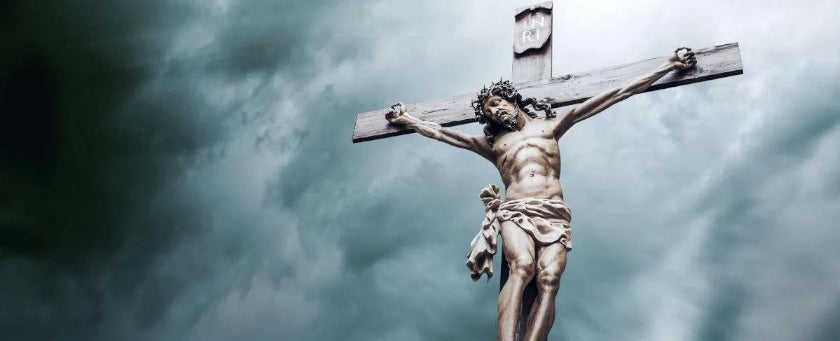
“There is a baptism with which I must be baptized, and how great is my anguish until it is accomplished!” These words from today’s gospel show how great Jesus’ desire is to accomplish the work of salvation. The baptism Jesus is describing is his own Passion and death on the Cross. Why does Jesus say he is in anguish until it is accomplished? Because the whole world was completely engulfed by sin, and the only solution would be for him to undergo the baptism of death on the Cross. Christ’s baptism is the offering of a perfect sacrifice to the Father, to appease the Father’s wrath, and open the gates of heaven to all who believe.
Jesus warns that from then on there will not be peace, but division, particularly among families. We feel this division even today, as many of our own family members have fallen away from the faith. They have been enticed by the world, choosing worldly things rather than the truth of Christ. It was a similar situation for the prophet Jeremiah. He was sent by God to speak to a people who would not listen. Eventually, they grew tired of listening to his rebuke. He was calling them out for their sins. No one likes to admit they are wrong. One of those most difficult conversations to have is one that involves admonishment. At the heart of the prophet’s message is for the people to change from their evil ways so that the Lord may relent from punishing them for their sins. Not even the king can dissuade them from attempting to kill Jeremiah.
Kings have no power unless it comes from above (cf. Jn. 19:11). That is to say, if they loose their faith, if they give in to sin, if they fail to keep the commandments, they will be no different than all the rest. What separates a good leader from a bad one? Saturday was the feast of St. Stephen of Hungary, one of Europe’s greatest kings. Listen to the advice he gives to his son about being a good king:
“My dearest son, if you desire to honor the royal crown, I advise, I counsel, I urge you above all things to maintain the Catholic and apostolic faith with such diligence and care that you may be an example for all those placed under you by God and that all the clergy may rightly call you a man of true Christian profession…Finally, be strong lest prosperity lift you up too much or adversity cast you down. Be humble in this life, that God may raise you up in the next. Be truly moderate and do not punish or condemn anyone immoderately. Be gentle so that you may never oppose justice. Be honorable so that you may never voluntarily bring disgrace upon anyone. Be chaste so that you may avoid all the foulness of lust like the pangs of death” (From admonitions to his son by St. Stephen).
What if more of our leaders spoke like this today? What if more of our leaders realized that their authority comes not from within, but from without? What if more of our leaders sought to be virtuous by imitating Christ? What if such a movement started with each of us? Because that is ultimately what St. Paul is telling us to do in the letter to the Hebrews.
St. Paul says, “Since we are surrounded by so great a cloud of witnesses, let us rid ourselves of every burden and sin that clings to us and persevere in running the race that lies before us while keeping our eyes fixed on Jesus, the leader and perfecter of faith.” In other words, we look to the example of the saints—men and women who led lives of exceptional virtue and faith—and keep our eyes on Christ. Before I was ordained, Bishop O’Connell gave a retreat for our class. On the last day of the retreat, the bishop encouraged us to keep Christ at the center of our lives. I will never forget that admonishment, and have always sought to do so for myself and those to whom I minister.
The life of the Christian is often met with difficulties. We are like Peter walking on the water. When he becomes overwhelmed by the storm, he begins to sink. But, Jesus is with us always, especially for those who keep the faith, for those who keep Christ at the center of their lives. When Peter begins sinking, he cries out, “Lord, save me!” How often do we do the same? Do we pray the Lord to deliver us from evil, or do we think we can handle it ourselves? It is difficult to surrender to a man because it makes us a slave, but to surrender to God truly sets us free.
Jesus shows us how to surrender to God through the Cross. In the garden of Gethsemane he prays, “My Father, if it is possible, let this cup pass from me; yet, not as I will, but as you will” (Mt. 26:39). God has a plan for each of us, which is good. God cannot will evil. What is God’s plan for our life? We do well to pray like Jesus. Let us ask God to reveal it to us.
And so, as we prepare to celebrate the Eucharist, may the communion we share unite us with Jesus, the source of our salvation, and may we always seek to keep Christ at the center of our life. By doing so, it may bring division, especially among those who reject Christ, but through our witness, like the Saints of old, we become ambassadors of Christ. When we do this, we will truly be on fire for the Lord. A fire which burns away the bad in us and brings warmth and comfort to everyone else.

Share this post
Twitter
Facebook
Pinterest
Email